

Google’s ranking algorithm now prioritises provable expertise over perfect keyword placement. The businesses winning visibility in 2026 are the ones that can demonstrate experience, establish authority, and build verifiable trust signals across their digital presence.
E-E-A-T—Experience, Expertise, Authoritativeness, and Trustworthiness—represents the framework Google uses to assess content credibility. These signals determine whether your content gets featured in AI Overviews, ranks prominently, or gets buried beneath competitors with stronger credibility markers.
Understanding what E-E-A-T signals are and how to strengthen them matters more than traditional SEO tactics. The shift from keyword optimisation to credibility optimisation changes what gets results especially for brands investing in professional SEO services rather than quick fixes.
E-E-A-T represents the framework Google uses to assess whether content comes from legitimate, qualified sources. Each letter addresses a specific dimension of credibility.
Experience means demonstrating you have personally done, used, or lived what you write about. Google added this “E” in 2022 because expertise alone does not guarantee practical knowledge.
A doctor with medical credentials has expertise. A patient who successfully managed a chronic condition through specific treatments has experience. Both perspectives carry value, but they differ fundamentally.
Experience shows through:
An accounting firm discussing tax strategies gains credibility by showing actual client results. A financial adviser writing about investment approaches strengthens E-E-A-T by referencing real portfolio performance with permission.
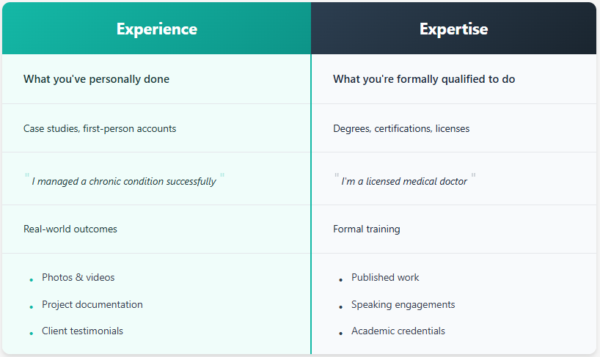
Expertise represents formal knowledge, training, credentials, and recognised skill in a field. This might include degrees, certifications, professional memberships, or years practicing a specific discipline.
Google looks for expertise signals like:
A lawyer writing about property law demonstrates expertise through legal credentials and bar admission. An electrician discussing electrical safety shows expertise through trade licences and completed apprenticeships. Expertise answers “what qualifies you to speak on this topic?”
Authoritativeness means others in your industry and field recognise you as a leading voice or trusted source. This reputation extends beyond self-promotion to third-party validation.
Authority signals include:
A marketing agency demonstrates authority when business publications quote their insights or industry blogs reference their strategies. Authority is not something you claim—it is something others acknowledge through their recognition and references.
Trust represents the overall credibility and reliability users and Google place in your site. Trust encompasses security, transparency, accuracy, and consistency.
Google evaluates trust through:
Trust is the umbrella covering the other elements. You might have experience, expertise, and authority, but if your site lacks security, hides contact details, or has negative reviews highlighting dishonesty, trust collapses and E-E-A-T fails.
Traditional SEO focused on keywords and backlinks. Modern SEO prioritises proving you deserve to rank through demonstrated credibility.
Google’s shift toward E-E-A-T reflects two major priorities: protecting users from misinformation and providing AI systems with trustworthy sources.
Google faces increasing pressure to prevent harmful misinformation from ranking highly, particularly for topics affecting health, safety, finances, and major life decisions. These areas fall under “Your Money or Your Life” (YMYL) categories where poor information causes real harm.
A medical site without clear author credentials might give dangerous health advice. A financial blog without expertise could recommend risky investments. A legal site without qualified authors might provide incorrect guidance with serious consequences.
Google uses E-E-A-T to filter content in sensitive categories:
Even outside YMYL categories, Google increasingly favours content from verifiable sources. The cost of promoting untrustworthy information in any category has become too high.
AI-powered search features like Google’s AI Overviews and ChatGPT Search need reliable sources to synthesise accurate responses. These systems cannot verify truth independently—they rely on E-E-A-T signals to identify credible sources worth citing.
When AI generates answers, it prioritises content from sites with strong E-E-A-T because those signals suggest accuracy and reliability. Sites with weak E-E-A-T get excluded from AI responses even if their content quality seems acceptable.
This makes E-E-A-T essential for visibility in 2026. Traditional search results show ten options. AI-generated answers might cite three sources maximum. Only brands with strongest E-E-A-T make that cut.
Google does not publish an E-E-A-T score, but it evaluates specific signals across your site and the broader web to assess credibility.
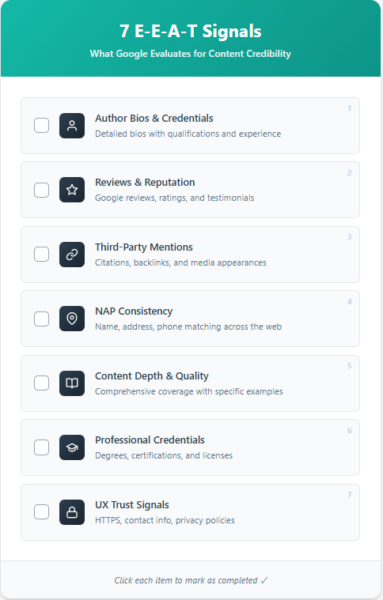
1. Author Bios and Credentials
Detailed author bios showing qualifications, experience, and expertise help Google verify content comes from qualified sources. Include relevant credentials, years of experience, professional affiliations, and links to author social profiles or professional sites.
2. Reviews and Reputation
Google reviews, Trustpilot ratings, industry-specific review platforms, and Better Business Bureau profiles all contribute to trust signals. Positive reviews with specific details strengthen E-E-A-T while negative reviews citing dishonesty or incompetence damage it significantly.
3. Third-Party Mentions
When authoritative sites mention your brand, link to your content, or quote your expertise, Google interprets this as external validation. Media appearances, industry blog citations, and expert roundup inclusions all build authoritativeness.
4. Consistency Across the Web
NAP (name, address, phone) consistency across directories, conflicting information about credentials or services, and inconsistent brand representation damage trust. Google looks for consistency as a trust signal—if information about you varies across platforms, reliability appears questionable.
5. Content Depth and Quality
Superficial content covering topics shallowly suggests lack of expertise. Comprehensive, detailed content demonstrating nuanced understanding signals genuine knowledge. Content depth includes citing sources, acknowledging complexity, and providing specific examples.
6. Professional Credentials
Relevant qualifications matter significantly for YMYL topics. Medical degrees for health content, legal credentials for legal advice, financial certifications for investment guidance—these credentials directly influence E-E-A-T strength.
7. UX Trust Signals
Technical elements affect trust: HTTPS security, clear contact pages, transparent privacy policies, professional web design, fast loading, and mobile optimisation. Poor user experience suggests low attention to quality and damages overall trust.
Many Australian businesses work with agencies such as DCB Digital to audit these signals and identify which E-E-A-T elements need strengthening for improved visibility.
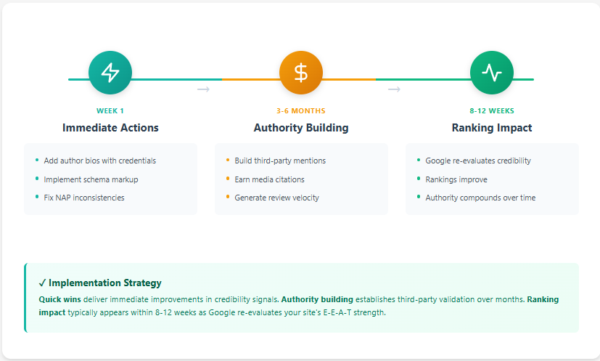
Strengthening E-E-A-T does not require expensive overhauls. Specific, actionable steps improve credibility signals Google evaluates.
Add Real Authorship to Content
Stop publishing anonymous content. Add author names, detailed bios, credentials, and photos to every significant page and blog post. Link author names to comprehensive bio pages showing expertise and experience.
Publish Expertise-Led Content
Shift from generic how-to content to insight-driven pieces demonstrating deep knowledge. Include specific examples from real work, discuss nuances and exceptions, acknowledge what remains uncertain, and provide level of detail only genuine experts possess.
Implement Proper Schema Markup
Schema tells Google exactly who you are, what credentials authors hold, what topics you cover, and how content relates to your expertise. Organisation schema, Author schema, Article schema, and Review schema all strengthen E-E-A-T signals.
Build Brand Authority Strategically
Actively pursue opportunities that build third-party validation:
Strengthen Review Profiles
Systematically request reviews from satisfied clients on Google and relevant platforms. Respond professionally to all reviews including negative ones. High review volume with specific positive details strengthens trust significantly.
Ensure Web Consistency
Audit your NAP across all directories and citations. Update outdated information. Ensure your credentials, service descriptions, and company details match everywhere your business appears online.
For businesses seeking systematic E-E-A-T improvement, working with specialists such as DCB Digital provides structured audits identifying exact signals needing attention and implementing changes that improve Google’s perception of credibility.
Certain E-E-A-T failures damage rankings more severely than others. Avoiding these mistakes protects visibility.
Publishing Generic Content Without Unique Insight
Content that could have been written by anyone without subject knowledge fails E-E-A-T evaluation. Google increasingly detects and devalues generic content that demonstrates no genuine expertise.
No Author Attribution
Anonymous content lacks accountability and credibility. Without knowing who wrote content or why they are qualified, Google cannot assess expertise or experience.
Thin Pages With Minimal Value
Superficial coverage suggests lack of deep knowledge. Pages that fail to answer questions comprehensively or provide actionable detail appear low-quality regardless of keyword optimisation.
Inconsistent Business Information
Different addresses, phone numbers, or business descriptions across the web signal unreliability. This inconsistency damages trust and suggests poor attention to accuracy.
Ignoring Reviews and Reputation
Businesses that accumulate negative reviews without response or that lack reviews entirely appear less trustworthy than competitors with strong, managed review profiles.
An E-E-A-T audit reveals exactly which trust signals are strong, which are missing, and which actively damage your rankings. Most Australian businesses discover significant gaps in author attribution, inconsistent information across the web, or missing schema markup that prevents Google from recognising their expertise.
Fixing these gaps often improves rankings within 8-12 weeks as Google re-evaluates your site’s credibility signals. The businesses investing in E-E-A-T now will establish authority that compounds over time and becomes increasingly difficult for competitors to match.
Book your E-E-A-T audit with DCB Digital today and discover precisely what Google sees when it evaluates your expertise, experience, authority, and trustworthiness.
No. While E-E-A-T matters most for health, finance, and legal content, Google increasingly applies these standards across all topics. Any content benefits from strong credibility signals.
Yes. E-E-A-T rewards genuine expertise and experience, not business size. Small businesses with deep subject knowledge and proper documentation often outrank larger competitors with weaker expertise signals.
Some changes like adding author bios and implementing schema can improve signals immediately. Building authority through mentions and reviews takes 3-6 months. Significant ranking improvements typically appear within 8-12 weeks.
Not always. Experience and demonstrable knowledge matter significantly. For YMYL topics, credentials help substantially. For other topics, proven experience and third-party recognition suffice.
Partially. Adding author bios, implementing schema, building citations, and managing reviews improve E-E-A-T without content changes. However, content demonstrating deep expertise remains essential for strong E-E-A-T overall.