
Search engines don’t care who wrote your content. People do.
As AI tools flood the web with faster, cheaper copy, the question isn’t just “Can it rank?” It’s “Will anyone click, read, or trust it?” That’s where the real difference shows up.
At DCB Digital, we help businesses cut through the noise with smart, strategy-led content. We use AI when it makes sense and human-crafted copy when it matters most.
In this guide, we’ll break down how AI-generated content stacks up against human-written work when it comes to rankings, clicks, and engagement. You’ll see what the data says, where each type performs best, and how to use both to build a content strategy that actually gets results.
Let’s start with the numbers.
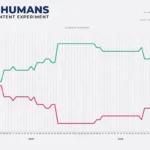
In a 2024 Semrush study of 20,000 blog posts, AI-written content ranked in the top 10 search results almost as often as human-written content. The difference was small: 57% for AI compared to 58% for human copy. From a rankings perspective, AI content can absolutely compete.
But rankings are only part of the story. In real-world tests, AI-assisted content often outperforms when a human steps in to refine it. One site recorded a click-through rate nearly 10 times higher on AI-plus-human content compared to pages written only by humans. It wasn’t just about keywords. Structure, clarity, and relevance made the difference.
However, when content is fully AI-generated and left unedited, performance tends to drop. Bounce rates go up. Time on page goes down. Google may still index and rank the page, but real users don’t engage in the same way. So while AI can hold its own in search results, human input still plays a critical role in user experience.
For a broader perspective on how AI is reshaping SEO, explore our insights on SEO Trends in 2025.
AI is a productivity tool. It helps you move fast, publish more, and fill content gaps across your site. For topics that are simple, factual, or repetitive like product descriptions, service lists, or glossary pages, AI can get the job done quickly and at scale.
It also works well at the start of your content process. You can use it to outline a blog, draft a first version, or surface keywords you may have missed. For informational posts that don’t require a strong opinion or deep expertise, AI-generated content can still rank and attract clicks.
But it’s not a set-and-forget solution. The best results come when a human editor steps in to review, refine, and align the content with your brand. AI handles the output. You handle the quality.
When the goal is to build trust, shape perception, or influence action, human-written content is the better choice. It captures nuance, adds depth, and reflects your brand’s voice in a way AI tools can’t replicate.
This matters most for pages that carry weight. Think about long-form guides, thought leadership articles, or service content where tone and clarity drive conversions. A skilled writer brings originality, structure, and intent that AI-generated copy often lacks.
Google rewards content that shows real experience and insight. So if you’re aiming to lead in your space, build authority, or tell a story that resonates, this is where a professional copywriter earns their spot in the strategy.
Knowing when to use AI and when to rely on human writers comes down to purpose. Not every blog post needs a handcrafted narrative, and some content types are better suited to automation than others.
To help you make the call, here’s a side-by-side comparison of when each option delivers the most value. Use this table to guide your content planning and match the right approach to the job at hand.
| Use Case | AI-Generated Content | Human-Written Content |
| Speed and Scale | Ideal for producing large volumes quickly | Slower to produce, better for select priorities |
| Simple or Repetitive Topics | Great for FAQs, glossaries, and product copy | May be overkill for repetitive formats |
| First Drafts and Outlines | Useful for structuring ideas and flow | Refines structure, tone, and narrative |
| Tone and Voice | Needs manual input to align with brand | Captures voice and intent naturally |
| Engagement and Persuasion | Can fall flat without editing | Stronger emotional and strategic impact |
| Trust and Authority | Lacks personal experience and nuance | Builds credibility through insight and context |
| Best Fit For | Supporting content, early drafts, bulk tasks | Landing pages, long-form blogs, brand messaging |
AI-generated content often pulls from existing material online, which can lead to phrasing that’s too similar to other websites. Without original insight or value, this content may be flagged as duplicate or deemed low quality by Google, resulting in lower rankings or de-indexing.
As global regulations evolve, businesses may be required to disclose when AI is used. If your content lacks proper human oversight or clear authorship, you risk falling out of compliance and losing user trust, especially in industries where transparency is key.
AI doesn’t fact-check itself. It can present outdated or incorrect information as truth. Publishing this without review can damage your credibility and potentially mislead your audience. Human editors are essential for verifying facts, maintaining tone, and aligning content with your brand’s message.
AI is changing the way we create content, but it’s not a replacement for human strategy. It’s a tool. A fast one. A useful one. But one that still needs the right guidance to deliver real results.
If you want to rank, engage, and convert, the smart move is to use both. Let AI handle the heavy lifting. Let your team shape the message, sharpen the voice, and align the content with what your audience actually needs.
At DCB Digital, we help brands build content that performs. Our SEO services are designed to help you craft strategies that combine the efficiency of AI with the nuance of human creativity. If you’re ready to level up your strategy or want advice on what approach suits your business, get in touch with our team. We’re here to make your content work harder.